
Invaluable Recyclers Café: Cultivating PRIDE - Pride, Respect, Identity, Dignity and Empowerment among Bengaluru’s waste pickers
By Beula Anthony, Project Officer, PRIDE; Neema Gupta, Research Manager; and Sajal Maji, Creative Supervisor, BBC Media Action
"An ungrievable life is one that cannot be mourned because it has never lived, that is, it has never counted as a life at all. Without grievability, there is no life, or, rather, there is something living that is other than life."
Judith Butler, in “Frames of War: When is Life Grievable?”, explains how societies render certain lives invisible. She describes how social “frames” determine whose lives are considered worthy of grief and whose are not, thereby assigning differential value.
Our formative research in 2020 revealed similar patterns about waste pickers in Bengaluru. While people of Bengaluru expressed concern about waste visible on the streets, they rarely acknowledged the humans behind waste management. The research exposed deep-rooted stigma and negative perceptions that eroded waste pickers’ sense of dignity and self-worth, further limiting their opportunities for growth, support, and recognition. As a result, waste pickers often hid behind their own “invisibility” to cope with discrimination, bullying, and fears for their safety; shaping how they saw themselves.
The invisibility of waste pickers stands in sharp contrast to how deeply our everyday lives depend on their work, especially as environmental risks increasingly affect us all. Recognising this interconnectedness between our lives and the labour of waste pickers is essential for the former to truly value the lives and work of the latter.
This is what we set in motion with #Invaluables, a social media campaign supported by on-ground activations and outdoor outreach. Together, these efforts helped Bengalureans move from seeing waste pickers as “dirty” to recognising them as skilled, essential contributors to society and environmental sustainability.
But how do you change it for waste pickers who have been internalizing these over years and even centuries? How do you instill confidence and self-worth while also challenging the age‑old discrimination and stigma they continue to face?
This thought led to the idea of the Invaluable Recyclers Café, an outreach intervention, born from the need to build a sense of agency among the waste pickers. A café is aspirational. It evokes the sense of warmth, equality, and the simple act of friends sitting together in conversation. Its informality creates a space to unpack experiences, learn, and grow, nurturing a sense of self‑worth and professional pride.
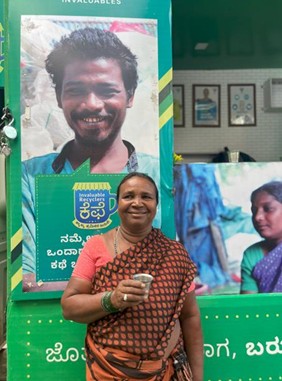
By combining skill-building, entertainment, and recognition, the Café served as a catalyst to:
Set up in a brightly branded mobile van, the initiative was officially launched on June 17, 2025 at Hasiru Habba – the annual celebration of waste pickers in Karnataka – by the Karnataka Minister for Forest, Environment and Ecology. It then travelled across waste picker neighbourhoods as both a training and engagement space. The van entered each locality playing ‘Happy Number – 38,32,50,000’ – a song celebrating waste pickers’ contributions that has become a community anthem since its launch in 2022.
Over 54 days, the Café travelled to 38 locations, engaging 1,233 waste pickers and their families directly and reaching more than 4,000 people – turning communities into lively spaces for dialogue and recognition. The Café runs on the power of collaboration of the collective i.e. Saamuhika Shakti. Hasiru Dala anchored the implementation of the initiative, working closely with our team to co-create activities and engagement plans, while Sparsha Trust and Sambhav Foundation contributed education and skill-building components.
The Café was designed as a space for learning and growth for waste picker communities. Positive deviant stories, shared through short films on textile waste and the importance of using Personal Protective Equipment (PPE), helped spark multiple conversations. Many participants learned for the first time about income opportunities in textile waste, the textile recovery facility, and the need for fair pricing. The story of Anitha, a community member, demonstrated how sorting and upcycling garments can become a viable source of income.
Anita, a local waste picker from Bengaluru, has shown how collecting and sorting textile waste can open new opportunities. After attending the Green Skill training conducted by Hasiru Dala, she was inspired by the journey of Indhumathi — a fellow waste picker turned entrepreneur who now runs a Textile Recovery Facility (TRF) and aspired to follow a similar path. With foundational knowledge in door‑to‑door waste collection, Anita began independently collecting and sorting textile waste, eventually supplying several tonnes to Indhumathi’s TRF. Today, as a scrap shop owner, she actively educates community members about textile recycling, upcycling, downcycling, and starting small waste‑based businesses, turning discarded clothes into sustainable livelihoods.
A female waste picker from Vinayaka Layout who participated in BBC Media Action’s effectiveness monitoring remarked, “We did not know, before this coffee gaadi came to us, that there is benefit in collecting waste clothes and that it can be useful.”
The Café also screened episodes from the Coffee with Recyclers series, featuring community members sharing their journeys. The story of Indumathi and how she became an entrepreneur running TRF from a waste picker and a global ambassador for the community inspired others to imagine such futures for their children. “Today I am a sorter; tomorrow I will become an entrepreneur like Indhumathi,” said a female waste picker from Nagarbhavi Circle.
PPE sessions managed by Hasiru Dala emphasised the need for safety and hygiene in daily work. The session focused on the benefits of wearing PPE at work by facilitating exchange of lived experiences and videos showing real-life injuries sustained due to lack of PPE. The session prompted strong reflection amongst the audiences around the need and use of PPE.
A male waste picker from Kunthigrama shared, “If we get sick, how can we work?” Another from Medi Agrahara added, “Now we remember that safety is important for our future.”
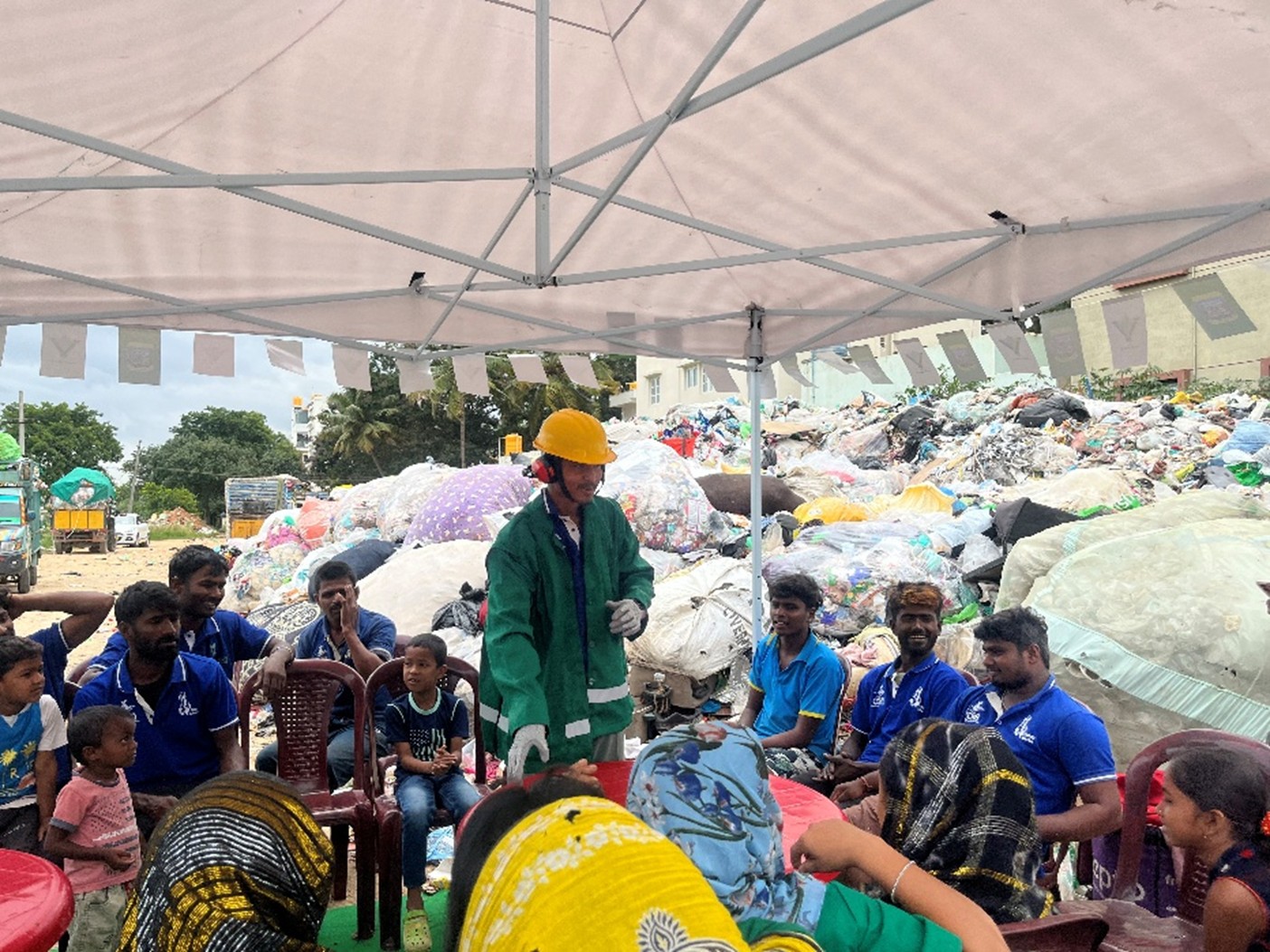
The Café also served as a safe space for conversations on social security, government welfare schemes, and community well-being. Participants received guidance on essential documents – ration cards, Aadhaar, PAN cards, and labour cards – required to access welfare schemes and protect waste picker rights.
Sparsha Trust focused on raising awareness about the importance of health and education. They distributed nutrition kits to mothers, science kits to children, and conducted sessions on menstrual health, among other initiatives. Sambhav Foundation organised creative and skill‑building activities, including Friendship Day celebrations featuring 100 handmade friendship bands by waste pickers, along with life skills training.
It also addressed critical social issues like substance abuse, child marriage, and nutrition. Participants committed to positive actions, reinforcing the Café as a hub for learning, dialogue, and community empowerment.
It also turned into a platform for community members to showcase their talents. Singing, dancing, and performances brought energy to the gatherings, with many holding a microphone for the first time. Community leaders spoke about the importance of education and encouraged others to share their voices. These moments fostered confidence, pride, and a stronger sense of identity, positioning the Café as a space where skills, stories, and achievements could be openly celebrated.
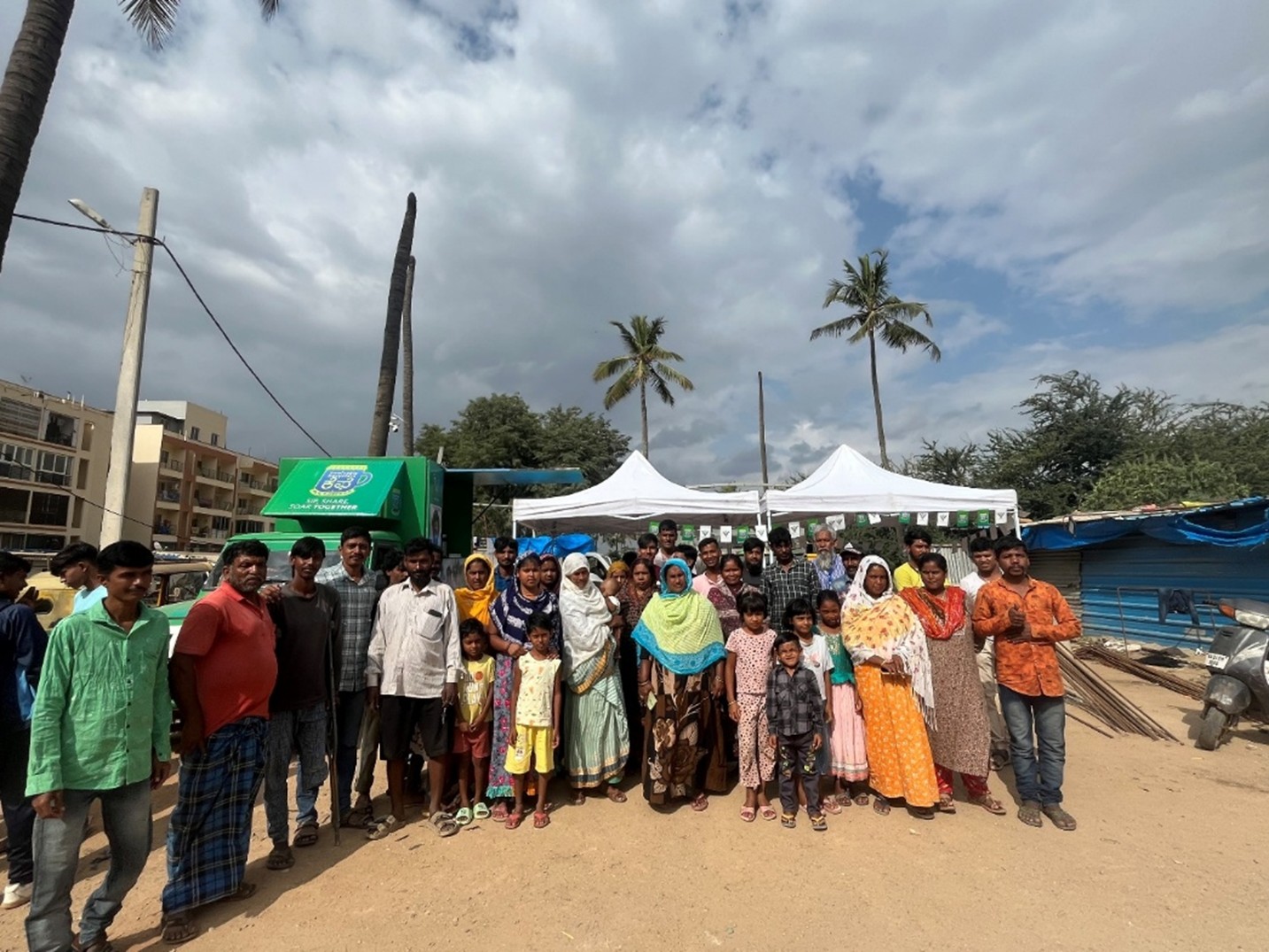
BBC Media Action’s effectiveness monitoring at the end of the intervention showed that these interactions increased awareness, confidence, pride, and a stronger sense of belonging among waste pickers. The Café demonstrated that agency and recognition are precursors to behaviour change, with participants more likely to adopt protective gear, explore new income streams like textile recycling, and access welfare schemes when they felt valued and confident in their identity.
During its run, the Café emerged not just as a mobile learning hub but as a catalyst for pride, empowerment, and change within waste picker communities. “The Café is helping us feel confident and connected,” shared a male waste picker from Vinayaka Garden in Bengaluru.
“Café is a platform for the community.”
– A female waste picker from Akkiyappa Garden
Invaluable Recyclers Café: Cultivating PRIDE - Pride, Respect, Identity, Dignity and Empowerment among Bengaluru’s waste pickers
By Beula Anthony, Project Officer, PRIDE; Neema Gupta, Research Manager; and Sajal Maji, Creative Supervisor, BBC Media Action
"An ungrievable life is one that cannot be mourned because it has never lived, that is, it has never counted as a life at all. Without grievability, there is no life, or, rather, there is something living that is other than life."
Judith Butler, in “Frames of War: When is Life Grievable?”, explains how societies render certain lives invisible. She describes how social “frames” determine whose lives are considered worthy of grief and whose are not, thereby assigning differential value.
Our formative research in 2020 revealed similar patterns about waste pickers in Bengaluru. While people of Bengaluru expressed concern about waste visible on the streets, they rarely acknowledged the humans behind waste management. The research exposed deep-rooted stigma and negative perceptions that eroded waste pickers’ sense of dignity and self-worth, further limiting their opportunities for growth, support, and recognition. As a result, waste pickers often hid behind their own “invisibility” to cope with discrimination, bullying, and fears for their safety; shaping how they saw themselves.
The invisibility of waste pickers stands in sharp contrast to how deeply our everyday lives depend on their work, especially as environmental risks increasingly affect us all. Recognising this interconnectedness between our lives and the labour of waste pickers is essential for the former to truly value the lives and work of the latter.
This is what we set in motion with #Invaluables, a social media campaign supported by on-ground activations and outdoor outreach. Together, these efforts helped Bengalureans move from seeing waste pickers as “dirty” to recognising them as skilled, essential contributors to society and environmental sustainability.
But how do you change it for waste pickers who have been internalizing these over years and even centuries? How do you instill confidence and self-worth while also challenging the age‑old discrimination and stigma they continue to face?
This thought led to the idea of the Invaluable Recyclers Café, an outreach intervention, born from the need to build a sense of agency among the waste pickers. A café is aspirational. It evokes the sense of warmth, equality, and the simple act of friends sitting together in conversation. Its informality creates a space to unpack experiences, learn, and grow, nurturing a sense of self‑worth and professional pride.
By combining skill-building, entertainment, and recognition, the Café served as a catalyst to:
Set up in a brightly branded mobile van, the initiative was officially launched on June 17, 2025 at Hasiru Habba – the annual celebration of waste pickers in Karnataka – by the Karnataka Minister for Forest, Environment and Ecology. It then travelled across waste picker neighbourhoods as both a training and engagement space. The van entered each locality playing ‘Happy Number – 38,32,50,000’ – a song celebrating waste pickers’ contributions that has become a community anthem since its launch in 2022.
Over 54 days, the Café travelled to 38 locations, engaging 1,233 waste pickers and their families directly and reaching more than 4,000 people – turning communities into lively spaces for dialogue and recognition. The Café runs on the power of collaboration of the collective i.e. Saamuhika Shakti. Hasiru Dala anchored the implementation of the initiative, working closely with our team to co-create activities and engagement plans, while Sparsha Trust and Sambhav Foundation contributed education and skill-building components.
The Café was designed as a space for learning and growth for waste picker communities. Positive deviant stories, shared through short films on textile waste and the importance of using Personal Protective Equipment (PPE), helped spark multiple conversations. Many participants learned for the first time about income opportunities in textile waste, the textile recovery facility, and the need for fair pricing. The story of Anitha, a community member, demonstrated how sorting and upcycling garments can become a viable source of income.
Anita, a local waste picker from Bengaluru, has shown how collecting and sorting textile waste can open new opportunities. After attending the Green Skill training conducted by Hasiru Dala, she was inspired by the journey of Indhumathi — a fellow waste picker turned entrepreneur who now runs a Textile Recovery Facility (TRF) and aspired to follow a similar path. With foundational knowledge in door‑to‑door waste collection, Anita began independently collecting and sorting textile waste, eventually supplying several tonnes to Indhumathi’s TRF. Today, as a scrap shop owner, she actively educates community members about textile recycling, upcycling, downcycling, and starting small waste‑based businesses, turning discarded clothes into sustainable livelihoods.
A female waste picker from Vinayaka Layout who participated in BBC Media Action’s effectiveness monitoring remarked, “We did not know, before this coffee gaadi came to us, that there is benefit in collecting waste clothes and that it can be useful.”
The Café also screened episodes from the Coffee with Recyclers series, featuring community members sharing their journeys. The story of Indumathi and how she became an entrepreneur running TRF from a waste picker and a global ambassador for the community inspired others to imagine such futures for their children. “Today I am a sorter; tomorrow I will become an entrepreneur like Indhumathi,” said a female waste picker from Nagarbhavi Circle.
PPE sessions managed by Hasiru Dala emphasised the need for safety and hygiene in daily work. The session focused on the benefits of wearing PPE at work by facilitating exchange of lived experiences and videos showing real-life injuries sustained due to lack of PPE. The session prompted strong reflection amongst the audiences around the need and use of PPE.
A male waste picker from Kunthigrama shared, “If we get sick, how can we work?” Another from Medi Agrahara added, “Now we remember that safety is important for our future.”
The Café also served as a safe space for conversations on social security, government welfare schemes, and community well-being. Participants received guidance on essential documents – ration cards, Aadhaar, PAN cards, and labour cards – required to access welfare schemes and protect waste picker rights.
Sparsha Trust focused on raising awareness about the importance of health and education. They distributed nutrition kits to mothers, science kits to children, and conducted sessions on menstrual health, among other initiatives. Sambhav Foundation organised creative and skill‑building activities, including Friendship Day celebrations featuring 100 handmade friendship bands by waste pickers, along with life skills training.
It also addressed critical social issues like substance abuse, child marriage, and nutrition. Participants committed to positive actions, reinforcing the Café as a hub for learning, dialogue, and community empowerment.
It also turned into a platform for community members to showcase their talents. Singing, dancing, and performances brought energy to the gatherings, with many holding a microphone for the first time. Community leaders spoke about the importance of education and encouraged others to share their voices. These moments fostered confidence, pride, and a stronger sense of identity, positioning the Café as a space where skills, stories, and achievements could be openly celebrated.
BBC Media Action’s effectiveness monitoring at the end of the intervention showed that these interactions increased awareness, confidence, pride, and a stronger sense of belonging among waste pickers. The Café demonstrated that agency and recognition are precursors to behaviour change, with participants more likely to adopt protective gear, explore new income streams like textile recycling, and access welfare schemes when they felt valued and confident in their identity.
During its run, the Café emerged not just as a mobile learning hub but as a catalyst for pride, empowerment, and change within waste picker communities. “The Café is helping us feel confident and connected,” shared a male waste picker from Vinayaka Garden in Bengaluru.
“Café is a platform for the community.”
– A female waste picker from Akkiyappa Garden


