
By Ekta Sawant, Communications Manager, Saamuhika Shakti
With inputs from Chandrasekara NM, Head, Sree Nagesh Malladi, Technical Advisor and Vijayamma K , Manager, Programme Implementation Unit - South, Bal Raksha Bharat; Darshana S, Communication Executive and Revathi Krishnan, Head – Donor Communication, Sparsha Trust
A year ago, a simple yet powerful learning tool entered classrooms across Bengaluru’s Kannada-medium government schools. Designed as a bilingual Kannada–English dictionary for students from primary to high school, it has since grown into far more than a reference book. Today, it stands as a classroom companion, reshaping how children read, learn and express themselves, while building confidence across languages.
Developed by Bal Raksha Bharat in collaboration with the Department of State Educational Research and Training (DSERT), Karnataka, the pilot is being implemented in 100 schools across Karnataka by Bal Raksha Bharat and DSERT including the 30 schools supported by Sparsha Trust, partner in Phase 2 of the Saamuhika Shakti initiative. The bilingual dictionaries were envisioned by Bal Raksha Bharat during Phase 1 as a response to a persistent challenge in government schools: language as a barrier to learning rather than a bridge.

In a linguistically diverse city like Bengaluru, government classrooms include children from migrant families across the country, as well as those from waste picking and other marginalized communities. Many students navigate at least two unfamiliar languages, Kannada and English, often without adequate learning support at home. Teachers, in turn, face the complex task of teaching a multi-lingual classroom with limited resources.
Recognising this gap, curriculum-aligned Kannada–English bilingual dictionaries were developed for students in Classes 1–5 and 6–8 to support faster, deeper comprehension across subjects. Designed by Bal Raksha Bharat in technical collaboration with DSERT, the dictionaries were developed by over 50 state curriculum subjects experts across Kannada, English, Environment Studies, Science, Social Studies and Hindi, under the technical guidance of senior DSERT faculty.
Aligned to the state curriculum, the dictionaries enable students to easily refer to word meanings, spelling, pronunciation, grammar and usage, synonyms, and distinctions between spoken and written language, using simple sentences that bridge English with the mother tongue, Kannada. Organised alphabetically with guide words, they help build vocabulary, improve reading comprehension, and support age-appropriate learning outcomes for children from diverse linguistic backgrounds. Officially launched on December 24, 2024 at the DSERT Conference Hall, the initiative was welcomed by education leaders across Karnataka and beyond, who emphasised the power of simple, scalable solutions in strengthening foundational learning.
.jpeg)
In the first quarter of 2025, a pilot set of dictionaries was distributed to select government schools by Bal Raksha Bharat. Teachers were oriented on how to integrate the dictionary into classroom learning and encouraged to develop simple learning modules using the dictionary words. They were also asked to monitor usage and share feedback to help refine and strengthen the content.
As the pilot phase nears completion, the bilingual dictionaries will be refined through structured feedback loops with teachers and a technical review by experts recommended by DSERT. Bal Raksha Bharat is coordinating with DSERT and 100 schools to systematically collect feedback from teachers, students, and subject experts to inform the finalisation of the dictionaries.
In December, Sparsha Trust conducted a status check across 30 government schools in Bengaluru, where 5,300 copies of the dictionary had been distributed to students from primary to high school.
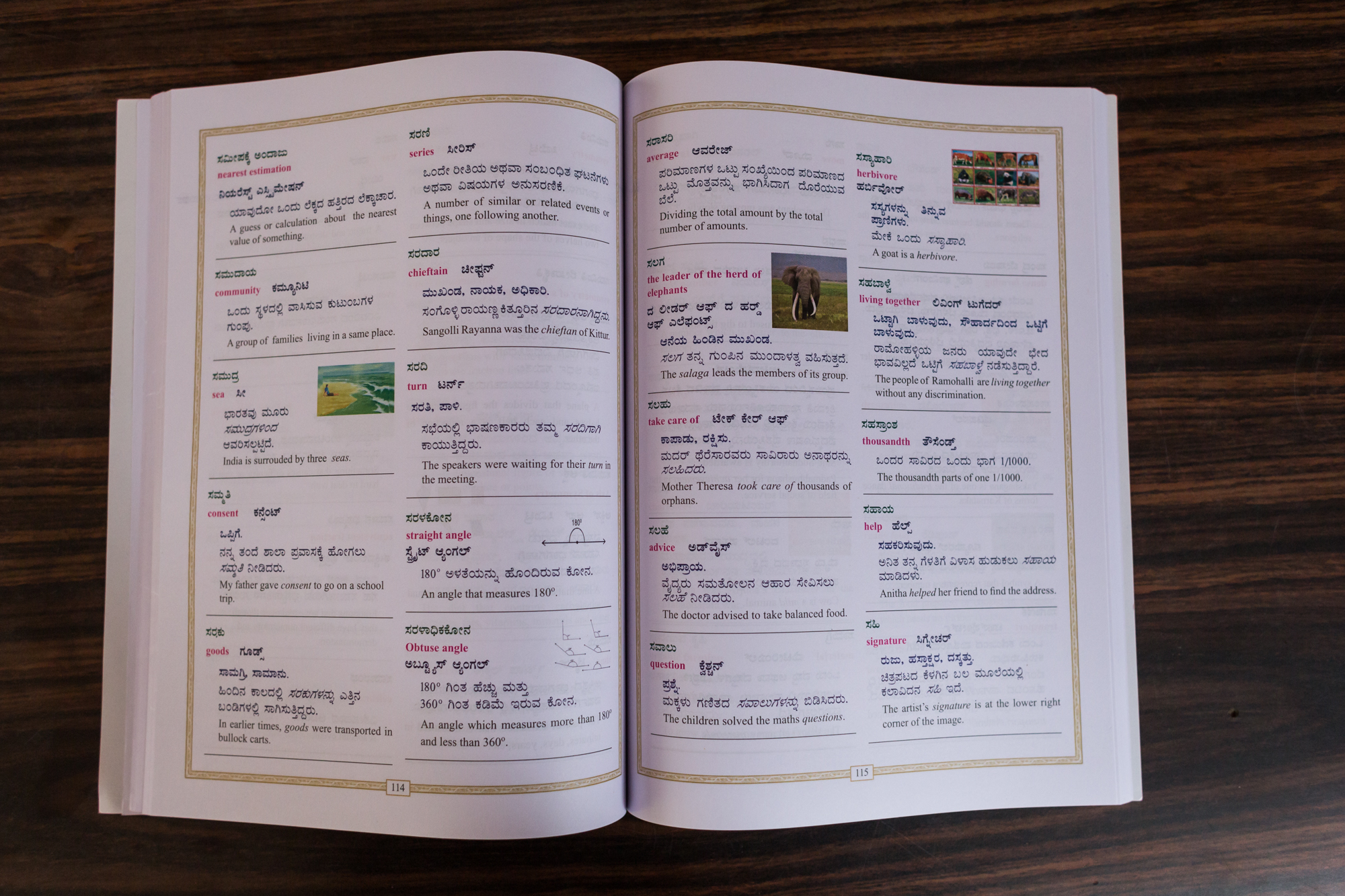
Teachers quickly observed that the dictionary’s design made it accessible and intuitive. Each word is presented in both Kannada and English, supported by contextual sentences and illustrations—allowing students to grasp meaning without relying solely on translation.
Usha, a teacher at Karnataka Public School, Sarakki, reflects:
“The bilingual dictionary stands out because of its well-organized alphabetical arrangement of Kannada and English words, which makes searching and learning extremely easy. This structure helps students quickly find words and improve their learning within a short time. I sincerely appreciate Sparsha Trust and Saamuhika Shakti for contributing to the enhancement of children’s vocabulary.”
For students, the difference was immediate. Lavana, a Class 5 student from Government Lower Primary School, Munneshwara Nagar, shares:
“This dictionary is different from a regular dictionary. Each word is explained in both Kannada and English, which makes it easier to understand. The pictures help explain meanings more clearly, and that makes learning more interesting.”
.jpeg)
For many Kannada-medium students, English vocabulary had earlier felt intimidating. Understanding textbook content, forming sentences or even attempting to read independently required constant teacher support. With the dictionary in hand, that dynamic began to shift.
Teachers introduced a simple daily practice: learning four new words each day. Over time, this small habit became a powerful routine – encouraging independent exploration, repetition and confidence-building.
For example, entries present words clearly across languages and contexts:
Direction – “The birds flew in the same direction.”
(ದಿಕ್ಕುಗಳು – ಪಕ್ಷಿಗಳು ಒಂದೇ ದಿಕ್ಕಿನಲ್ಲಿ ಹಾರಿದವು)
This dual-language structure allows children to anchor new English words in their strong Kannada foundation, rather than replacing one language with another.
Perhaps the most inspiring outcome has been how children themselves reimagined the dictionary’s use. What could have remained a static reference book became a playful, collaborative learning companion.
Across classrooms, teachers observed students creating their own vocabulary games:
These spontaneous innovations not only strengthened language skills but also nurtured curiosity, teamwork and joy – qualities often missing from rote learning environments.
.jpeg)
Research in language education shows that bilingual dictionaries play an important role in supporting second-language learning. By allowing students to connect new words to their first language, they improve vocabulary acquisition, reading comprehension, and learner confidence—particularly when used regularly and with teacher guidance (International Journal of Lexicography, Oxford University Press).
This transformation in learning and confidence is seen across the 30 schools. Teachers reported a consistent pattern of change, children who were once hesitant now engage actively with English. What previously felt difficult has become familiar and manageable.
Students are understanding textbook content more quickly, spending less time struggling with unfamiliar words and more time engaging with ideas. They are framing sentences with growing confidence, first in Kannada and increasingly in English, often attempting expressions they would earlier have avoided. Reading, once seen as difficult or intimidating, is beginning to spark interest and curiosity, leading to stronger comprehension. As confidence grows, classroom participation is increasing, with more children speaking up, asking questions and engaging in discussion. Over time, these changes are translating into improved learning outcomes.
Most significantly, teachers noticed a change that goes beyond academics: fear has given way to confidence.
.jpeg)
Importantly, this bilingual dictionary has not diluted Kannada learning; instead, it has strengthened it. By positioning English alongside the child’s first language, it validates linguistic identity while expanding opportunity. For Kannada-medium students, it serves as a vital bridge – connecting what they already know with what they are learning to access.
As the journey of this initiative continues, one thing is clear: meaningful educational change does not always require complex interventions. Sometimes, thoughtfully designed tools, rooted in classroom realities, can unlock confidence, curiosity and possibility.
A year on, the bilingual dictionary has opened a lasting door to language learning for thousands of children across Bengaluru. And for many of them, it is the first step towards dreaming, and learning, without fear and hesitation.
Note: Final version will be available post feedback sessions and review by DSERT, please email us for more information at saamuhikashakti@sattva.co.in
📺 If you would like to see this transformation come alive – through the voices of teachers and the curiosity of children – watch the short film capturing how the bilingual dictionary is being used in classrooms across Bengaluru: Conversations from the Field: How Kannada–English Dictionaries Are Building Confidence in Young Learners
By Ekta Sawant, Communications Manager, Saamuhika Shakti
With inputs from Chandrasekara NM, Head, Sree Nagesh Malladi, Technical Advisor and Vijayamma K , Manager, Programme Implementation Unit - South, Bal Raksha Bharat; Darshana S, Communication Executive and Revathi Krishnan, Head – Donor Communication, Sparsha Trust
A year ago, a simple yet powerful learning tool entered classrooms across Bengaluru’s Kannada-medium government schools. Designed as a bilingual Kannada–English dictionary for students from primary to high school, it has since grown into far more than a reference book. Today, it stands as a classroom companion, reshaping how children read, learn and express themselves, while building confidence across languages.
Developed by Bal Raksha Bharat in collaboration with the Department of State Educational Research and Training (DSERT), Karnataka, the pilot is being implemented in 100 schools across Karnataka by Bal Raksha Bharat and DSERT including the 30 schools supported by Sparsha Trust, partner in Phase 2 of the Saamuhika Shakti initiative. The bilingual dictionaries were envisioned by Bal Raksha Bharat during Phase 1 as a response to a persistent challenge in government schools: language as a barrier to learning rather than a bridge.
In a linguistically diverse city like Bengaluru, government classrooms include children from migrant families across the country, as well as those from waste picking and other marginalized communities. Many students navigate at least two unfamiliar languages, Kannada and English, often without adequate learning support at home. Teachers, in turn, face the complex task of teaching a multi-lingual classroom with limited resources.
Recognising this gap, curriculum-aligned Kannada–English bilingual dictionaries were developed for students in Classes 1–5 and 6–8 to support faster, deeper comprehension across subjects. Designed by Bal Raksha Bharat in technical collaboration with DSERT, the dictionaries were developed by over 50 state curriculum subjects experts across Kannada, English, Environment Studies, Science, Social Studies and Hindi, under the technical guidance of senior DSERT faculty.
Aligned to the state curriculum, the dictionaries enable students to easily refer to word meanings, spelling, pronunciation, grammar and usage, synonyms, and distinctions between spoken and written language, using simple sentences that bridge English with the mother tongue, Kannada. Organised alphabetically with guide words, they help build vocabulary, improve reading comprehension, and support age-appropriate learning outcomes for children from diverse linguistic backgrounds. Officially launched on December 24, 2024 at the DSERT Conference Hall, the initiative was welcomed by education leaders across Karnataka and beyond, who emphasised the power of simple, scalable solutions in strengthening foundational learning.
In the first quarter of 2025, a pilot set of dictionaries was distributed to select government schools by Bal Raksha Bharat. Teachers were oriented on how to integrate the dictionary into classroom learning and encouraged to develop simple learning modules using the dictionary words. They were also asked to monitor usage and share feedback to help refine and strengthen the content.
As the pilot phase nears completion, the bilingual dictionaries will be refined through structured feedback loops with teachers and a technical review by experts recommended by DSERT. Bal Raksha Bharat is coordinating with DSERT and 100 schools to systematically collect feedback from teachers, students, and subject experts to inform the finalisation of the dictionaries.
In December, Sparsha Trust conducted a status check across 30 government schools in Bengaluru, where 5,300 copies of the dictionary had been distributed to students from primary to high school.
Teachers quickly observed that the dictionary’s design made it accessible and intuitive. Each word is presented in both Kannada and English, supported by contextual sentences and illustrations—allowing students to grasp meaning without relying solely on translation.
Usha, a teacher at Karnataka Public School, Sarakki, reflects:
“The bilingual dictionary stands out because of its well-organized alphabetical arrangement of Kannada and English words, which makes searching and learning extremely easy. This structure helps students quickly find words and improve their learning within a short time. I sincerely appreciate Sparsha Trust and Saamuhika Shakti for contributing to the enhancement of children’s vocabulary.”
For students, the difference was immediate. Lavana, a Class 5 student from Government Lower Primary School, Munneshwara Nagar, shares:
“This dictionary is different from a regular dictionary. Each word is explained in both Kannada and English, which makes it easier to understand. The pictures help explain meanings more clearly, and that makes learning more interesting.”
For many Kannada-medium students, English vocabulary had earlier felt intimidating. Understanding textbook content, forming sentences or even attempting to read independently required constant teacher support. With the dictionary in hand, that dynamic began to shift.
Teachers introduced a simple daily practice: learning four new words each day. Over time, this small habit became a powerful routine – encouraging independent exploration, repetition and confidence-building.
For example, entries present words clearly across languages and contexts:
Direction – “The birds flew in the same direction.”
(ದಿಕ್ಕುಗಳು – ಪಕ್ಷಿಗಳು ಒಂದೇ ದಿಕ್ಕಿನಲ್ಲಿ ಹಾರಿದವು)
This dual-language structure allows children to anchor new English words in their strong Kannada foundation, rather than replacing one language with another.
Perhaps the most inspiring outcome has been how children themselves reimagined the dictionary’s use. What could have remained a static reference book became a playful, collaborative learning companion.
Across classrooms, teachers observed students creating their own vocabulary games:
These spontaneous innovations not only strengthened language skills but also nurtured curiosity, teamwork and joy – qualities often missing from rote learning environments.
Research in language education shows that bilingual dictionaries play an important role in supporting second-language learning. By allowing students to connect new words to their first language, they improve vocabulary acquisition, reading comprehension, and learner confidence—particularly when used regularly and with teacher guidance (International Journal of Lexicography, Oxford University Press).
This transformation in learning and confidence is seen across the 30 schools. Teachers reported a consistent pattern of change, children who were once hesitant now engage actively with English. What previously felt difficult has become familiar and manageable.
Students are understanding textbook content more quickly, spending less time struggling with unfamiliar words and more time engaging with ideas. They are framing sentences with growing confidence, first in Kannada and increasingly in English, often attempting expressions they would earlier have avoided. Reading, once seen as difficult or intimidating, is beginning to spark interest and curiosity, leading to stronger comprehension. As confidence grows, classroom participation is increasing, with more children speaking up, asking questions and engaging in discussion. Over time, these changes are translating into improved learning outcomes.
Most significantly, teachers noticed a change that goes beyond academics: fear has given way to confidence.
Importantly, this bilingual dictionary has not diluted Kannada learning; instead, it has strengthened it. By positioning English alongside the child’s first language, it validates linguistic identity while expanding opportunity. For Kannada-medium students, it serves as a vital bridge – connecting what they already know with what they are learning to access.
As the journey of this initiative continues, one thing is clear: meaningful educational change does not always require complex interventions. Sometimes, thoughtfully designed tools, rooted in classroom realities, can unlock confidence, curiosity and possibility.
A year on, the bilingual dictionary has opened a lasting door to language learning for thousands of children across Bengaluru. And for many of them, it is the first step towards dreaming, and learning, without fear and hesitation.
Note: Final version will be available post feedback sessions and review by DSERT, please email us for more information at saamuhikashakti@sattva.co.in
📺 If you would like to see this transformation come alive – through the voices of teachers and the curiosity of children – watch the short film capturing how the bilingual dictionary is being used in classrooms across Bengaluru: Conversations from the Field: How Kannada–English Dictionaries Are Building Confidence in Young Learners


