
Six years of learning on how programs can enable communities to shape their own futures.
By Jehosh Paul, MEL Consultant; Nimmi S, Gender & Community Leadership Lead and Shantanu Dubey, MEL Lead, Saamuhika Shakti
Waste pickers do essential work for Bengaluru, recovering and returning to the economy a large share of what the city discards. Yet, they remain among its least visible and least protected workers.
Saamuhika Shakti's ethnographic survey in 2019 surfaced the layered challenges waste pickers live with: unstable incomes tied to volatile scrap markets, limited access to social protection and governing institutions, language and literacy barriers, housing insecurity, and the stigma attached to handling waste. These challenges overlap and compound, each one narrowing the choices waste picker households can make in building a life of dignity and security.
Understanding these challenges early helped Saamuhika Shakti's partners align on a shared vision centred on ‘building agency’. By ‘agency’, the program means the ability of individuals and communities to make choices, act on them, negotiate with others, and engage with governing institutions with greater confidence. This vision, in turn, rested on three fundamental ideas:
This piece reflects on our approach and what it has begun to yield. It traces the multi-dimensional model that underpins the work; how equity and gender came alive through community-driven platforms; what agency looks like in practice through examples from the field; and some of the emerging, design and execution oriented learnings that have surfaced along the way.
Drawing on field observations and program evidence gathered across six years of work, the examples that follow should be read as early signals rather than final outcomes, but the direction of change is visible, and the lessons it surfaces matter for anyone designing programs for and with historically marginalised populations.
Saamuhika Shakti's approach has two connected parts: what the program does — a multi-dimensional architecture of interventions spanning needs, rights and dignity, and how that work is made to last — community-driven platforms that place ownership in the hands of waste pickers themselves. The first builds agency; the second roots it.
A Multi-Dimensional Architecture
Since inception, the program has operated with the belief that agency rests on met needs, secured rights and restored dignity. Hence, Saamuhika Shakti's interventions are designed as a single, multi-dimensional architecture — a set of complementary actions that each remove a barrier to choice and, together, strengthen the base from which waste picker families can act.
Community Platforms Where Agency Takes Root
Community-driven platforms are both an intervention in their own right and the connective tissue running through all the others — the spaces where layered support most visibly translates into voice and ownership, and where waste picker communities identify local issues and drive collective solutions. They are also how the program designs for sustainability - by lodging decision-making within community structures, change can continue beyond the life of any single intervention.
Across 67 localities, the program has supported over 262 active platforms, each responding to a different community need. Anchored on the ground by partner organisations within the collective - Hasiru Dala, Sambhav Foundation, Sparsha Trust and WaterAid India - they fall into two broad categories -
Together, these platforms create recurring spaces where community members can practise agency in everyday ways: saving regularly, discussing local issues, managing shared resources, approaching institutions and acting collectively.
The early signs of agency emerging through Saamuhika Shakti can be read across three levels: the household, the community and the institutional. At each level, families are not only making choices and acting on them but converting that agency into real social and economic leverage: a stronger voice at home, collective problem-solving in the neighbourhood, and an improved access to and engagement with governing institutions. These examples should be read as early evidence, not final outcomes.
For many women, agency first became visible in household-level negotiations. SHGs were introduced to encourage savings and mutual financial support, but their effects often extended beyond finance.
Members of the Dhanalakshmi SHG in Giripuram described how savings gave them greater confidence. Women who previously depended on others for small household expenses spoke about being able to make purchases independently.
“Previously it was not possible, but now we can buy something for ourselves since we have the savings amount.” — Member, Dhanalakshmi SHG
In Giddenahalli, women recalled that many husbands initially viewed SHGs with suspicion. Some feared that members would lose their savings. Over time, regular savings and visible financial discipline changed these perceptions. Husbands who once resisted participation began supporting it, and some deposited savings on behalf of their wives when work commitments prevented them from attending meetings.
These are not isolated cases. Across the programme, 1,545 waste picker women have been collectivised into 154 SHGs, with active groups saving an average of ₹5,089 over three months - a sign of how widely these peer groups now anchor routine savings, learning and support with localised decision-making in waste picker households.
This link between economic leverage and household agency is also clear in the case of Jeeva, a food vendor whose business had closed during the pandemic. With entrepreneurship support from Udhyam Learning Foundation, she cautiously restarted her stall and went on to grow her daily income 3.5 times over. That renewed confidence made her a role model within her own home. Inspired by her resilience and independence, her daughter has now begun selling evening snacks from the same stall, with hopes of building a food business of her own. Jeeva is one of more than 120 women nano-entrepreneurs moving along this path — economic leverage leading to greater agency.
These examples indicate that agency for women often requires negotiation within the household before it is exercised in public spaces. And that even early stages of financial independence can begin to shift a woman's standing at home.
In Summanahalli, members of Namma Jagali described how trusted platform members came together informally to mediate household domestic disputes within the locality. Rather than immediately approaching the police, community members attempted to resolve conflicts through discussion and collective intervention. The platform helped build relationships and trust that supported local problem-solving.
In the same locality, community members also responded to a service gap by deciding to contribute funds to hire an external cleaner when public toilet maintenance failed. This example is important because it shows agency not only as participation in a meeting, but as the ability to identify a problem, pool resources and act collectively.
“If there is any fight or issue, we sit here and clear it up instead of going to the police or elsewhere.” — Community Member at the Namma Jagali, Summanahalli
In another locality, residents mobilised around unequal access to water from a public sump. Some households were drawing a disproportionate share of water. Community members identified the issue, mobilised support and acted collectively around a shared public resource. This shows how community platforms can support collective action around everyday infrastructure concerns.
Collective agency at this level is also beginning to open economic possibilities. In TC Palya, male SHG members pooled resources to rent auto-rickshaws, enabling them to move beyond small-scale waste collection into more organised scrap trading. The example shows how collective networks, financial confidence and exposure to new possibilities can together support economic mobility.
In Giddenahalli, SHG members approached their bank to question unauthorised deductions from their accounts. This reflects growing confidence and improved capacity to engage with formal institutions.
.jpeg)
Waste pickers from Nagavara and Chokkasandra liaison with the Karnataka Slum Development Board (KSDB) for secured housing with amenities that include piped water, household electricity, sanitation (toilets/bathrooms), and drainage systems.
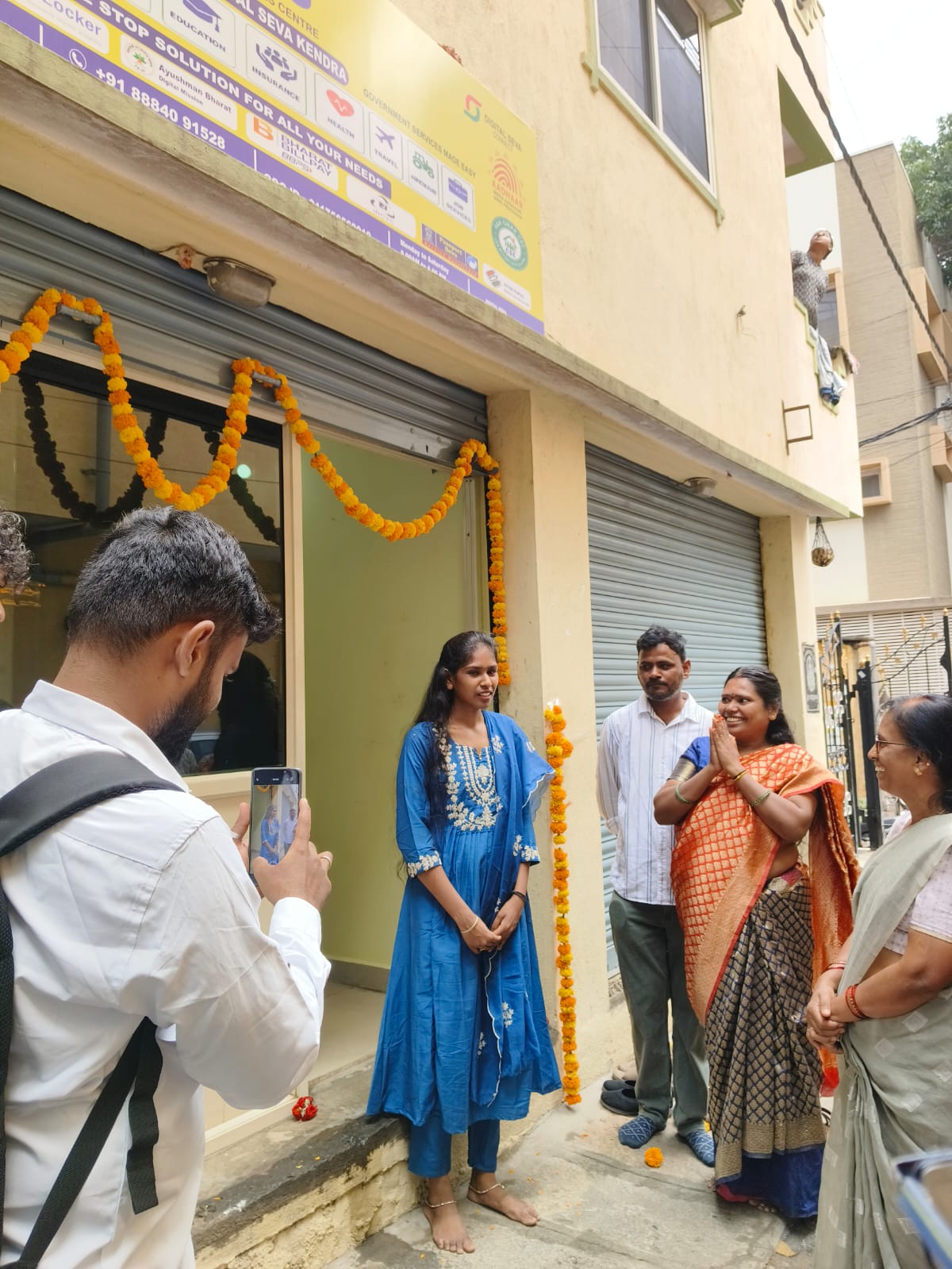
And in some cases, individuals are becoming providers of institutional access themselves. Saranya, a youth community representative trained and mentored by Hasiru Dala, was one of 22 to complete Common Services Centre (CSC) training and clear the CSC exam. She has now set up her own CSC center with support from Hasiru Dala. This center will improve social security access for waste pickers and other vulnerable groups, turning her own institutional agency into a route to security and livelihood for others.
These are a few of the many examples emerging every day. Taken together, they show agency in practical terms: saving, negotiating, speaking up, acting collectively, approaching institutions, managing local problems and exploring new livelihood opportunities. In many cases this agency remains early-stage and facilitation-supported. But across all three levels, the direction of change is visible.
The field evidence points to a set of design and execution oriented lessons for program working with hard-to-reach and historically marginalised communities.
.jpeg)
In conclusion, for programmes working with historically excluded communities, the lesson is straightforward but demanding — agency must be designed for. It calls for an integrated approach rather than single interventions, repeated spaces for participation rather than one-off engagement, facilitation that builds independence rather than dependence, and close attention to the local conditions in which communities actually live and work. Designed for in this way, agency becomes more than an outcome a program reports. It becomes something communities hold — and can carry forward on their own.
Six years of learning on how programs can enable communities to shape their own futures.
By Jehosh Paul, MEL Consultant; Nimmi S, Gender & Community Leadership Lead and Shantanu Dubey, MEL Lead, Saamuhika Shakti
Waste pickers do essential work for Bengaluru, recovering and returning to the economy a large share of what the city discards. Yet, they remain among its least visible and least protected workers.
Saamuhika Shakti's ethnographic survey in 2019 surfaced the layered challenges waste pickers live with: unstable incomes tied to volatile scrap markets, limited access to social protection and governing institutions, language and literacy barriers, housing insecurity, and the stigma attached to handling waste. These challenges overlap and compound, each one narrowing the choices waste picker households can make in building a life of dignity and security.
Understanding these challenges early helped Saamuhika Shakti's partners align on a shared vision centred on ‘building agency’. By ‘agency’, the program means the ability of individuals and communities to make choices, act on them, negotiate with others, and engage with governing institutions with greater confidence. This vision, in turn, rested on three fundamental ideas:
This piece reflects on our approach and what it has begun to yield. It traces the multi-dimensional model that underpins the work; how equity and gender came alive through community-driven platforms; what agency looks like in practice through examples from the field; and some of the emerging, design and execution oriented learnings that have surfaced along the way.
Drawing on field observations and program evidence gathered across six years of work, the examples that follow should be read as early signals rather than final outcomes, but the direction of change is visible, and the lessons it surfaces matter for anyone designing programs for and with historically marginalised populations.
Saamuhika Shakti's approach has two connected parts: what the program does — a multi-dimensional architecture of interventions spanning needs, rights and dignity, and how that work is made to last — community-driven platforms that place ownership in the hands of waste pickers themselves. The first builds agency; the second roots it.
A Multi-Dimensional Architecture
Since inception, the program has operated with the belief that agency rests on met needs, secured rights and restored dignity. Hence, Saamuhika Shakti's interventions are designed as a single, multi-dimensional architecture — a set of complementary actions that each remove a barrier to choice and, together, strengthen the base from which waste picker families can act.
Community Platforms Where Agency Takes Root
Community-driven platforms are both an intervention in their own right and the connective tissue running through all the others — the spaces where layered support most visibly translates into voice and ownership, and where waste picker communities identify local issues and drive collective solutions. They are also how the program designs for sustainability - by lodging decision-making within community structures, change can continue beyond the life of any single intervention.
Across 67 localities, the program has supported over 262 active platforms, each responding to a different community need. Anchored on the ground by partner organisations within the collective - Hasiru Dala, Sambhav Foundation, Sparsha Trust and WaterAid India - they fall into two broad categories -
Together, these platforms create recurring spaces where community members can practise agency in everyday ways: saving regularly, discussing local issues, managing shared resources, approaching institutions and acting collectively.
The early signs of agency emerging through Saamuhika Shakti can be read across three levels: the household, the community and the institutional. At each level, families are not only making choices and acting on them but converting that agency into real social and economic leverage: a stronger voice at home, collective problem-solving in the neighbourhood, and an improved access to and engagement with governing institutions. These examples should be read as early evidence, not final outcomes.
For many women, agency first became visible in household-level negotiations. SHGs were introduced to encourage savings and mutual financial support, but their effects often extended beyond finance.
Members of the Dhanalakshmi SHG in Giripuram described how savings gave them greater confidence. Women who previously depended on others for small household expenses spoke about being able to make purchases independently.
“Previously it was not possible, but now we can buy something for ourselves since we have the savings amount.” — Member, Dhanalakshmi SHG
In Giddenahalli, women recalled that many husbands initially viewed SHGs with suspicion. Some feared that members would lose their savings. Over time, regular savings and visible financial discipline changed these perceptions. Husbands who once resisted participation began supporting it, and some deposited savings on behalf of their wives when work commitments prevented them from attending meetings.
These are not isolated cases. Across the programme, 1,545 waste picker women have been collectivised into 154 SHGs, with active groups saving an average of ₹5,089 over three months - a sign of how widely these peer groups now anchor routine savings, learning and support with localised decision-making in waste picker households.
This link between economic leverage and household agency is also clear in the case of Jeeva, a food vendor whose business had closed during the pandemic. With entrepreneurship support from Udhyam Learning Foundation, she cautiously restarted her stall and went on to grow her daily income 3.5 times over. That renewed confidence made her a role model within her own home. Inspired by her resilience and independence, her daughter has now begun selling evening snacks from the same stall, with hopes of building a food business of her own. Jeeva is one of more than 120 women nano-entrepreneurs moving along this path — economic leverage leading to greater agency.
These examples indicate that agency for women often requires negotiation within the household before it is exercised in public spaces. And that even early stages of financial independence can begin to shift a woman's standing at home.
In Summanahalli, members of Namma Jagali described how trusted platform members came together informally to mediate household domestic disputes within the locality. Rather than immediately approaching the police, community members attempted to resolve conflicts through discussion and collective intervention. The platform helped build relationships and trust that supported local problem-solving.
In the same locality, community members also responded to a service gap by deciding to contribute funds to hire an external cleaner when public toilet maintenance failed. This example is important because it shows agency not only as participation in a meeting, but as the ability to identify a problem, pool resources and act collectively.
“If there is any fight or issue, we sit here and clear it up instead of going to the police or elsewhere.” — Community Member at the Namma Jagali, Summanahalli
In another locality, residents mobilised around unequal access to water from a public sump. Some households were drawing a disproportionate share of water. Community members identified the issue, mobilised support and acted collectively around a shared public resource. This shows how community platforms can support collective action around everyday infrastructure concerns.
Collective agency at this level is also beginning to open economic possibilities. In TC Palya, male SHG members pooled resources to rent auto-rickshaws, enabling them to move beyond small-scale waste collection into more organised scrap trading. The example shows how collective networks, financial confidence and exposure to new possibilities can together support economic mobility.
In Giddenahalli, SHG members approached their bank to question unauthorised deductions from their accounts. This reflects growing confidence and improved capacity to engage with formal institutions.
Waste pickers from Nagavara and Chokkasandra liaison with the Karnataka Slum Development Board (KSDB) for secured housing with amenities that include piped water, household electricity, sanitation (toilets/bathrooms), and drainage systems.
And in some cases, individuals are becoming providers of institutional access themselves. Saranya, a youth community representative trained and mentored by Hasiru Dala, was one of 22 to complete Common Services Centre (CSC) training and clear the CSC exam. She has now set up her own CSC center with support from Hasiru Dala. This center will improve social security access for waste pickers and other vulnerable groups, turning her own institutional agency into a route to security and livelihood for others.
These are a few of the many examples emerging every day. Taken together, they show agency in practical terms: saving, negotiating, speaking up, acting collectively, approaching institutions, managing local problems and exploring new livelihood opportunities. In many cases this agency remains early-stage and facilitation-supported. But across all three levels, the direction of change is visible.
The field evidence points to a set of design and execution oriented lessons for program working with hard-to-reach and historically marginalised communities.
In conclusion, for programmes working with historically excluded communities, the lesson is straightforward but demanding — agency must be designed for. It calls for an integrated approach rather than single interventions, repeated spaces for participation rather than one-off engagement, facilitation that builds independence rather than dependence, and close attention to the local conditions in which communities actually live and work. Designed for in this way, agency becomes more than an outcome a program reports. It becomes something communities hold — and can carry forward on their own.


