
By Gayathri Vasudevan, Co-founder & Chairperson, Sambhav Foundation
For most women in Bengaluru's waste picker settlements, money has always moved without a record. It came in from a day's collections and went out towards rent, food, school fees or a moneylender. Decisions about it were usually made by someone else.
Across 159 self-help groups (SHGs) formed with Sambhav Foundation, a Saamuhika Shakti implementing partner focused on livelihoods and skill development for Bengaluru's waste picker community, this is changing.
Women are saving together, lending to each other, walking into banks as account holders and, increasingly, maintaining their group's books themselves. Financial resilience is the visible result. Agency, a woman's ability to decide, question and act on her own terms, is what underpins it. And the ledger is where this transformation is easiest to see.
India has the world's largest women's SHG movement. As of June 2025, 10 crore women were organised into 91 lakh SHGs under the National Rural Livelihoods Mission, with a loan repayment rate above 96 per cent. A review of 34 SHG programmes, 18 of them in India, found tangible gains in women's economic control and community participation. However, this movement has grown largely through rural, formal channels, leaving Bengaluru's waste pickers outside almost all of them.
An estimated 22,500 waste pickers sort and recycle a large share of what Bengaluru discards, largely unrecognised and unprotected. Half of them are women, who earn roughly a third less than men for the same work. A typical waste picker woman had no savings to fall back on, no credit history that a bank would recognise and no collective identity that could be registered under a government scheme. When illness or a slow week of collections disrupted her income, the answer was usually a moneylender, whose interest rates could turn one bad month into several.
When Saamuhika Shakti was launched in November 2020, with Sambhav Foundation among its partners, the first survey found that only one in five women had ever belonged to a collective of any kind, while half believed household decisions should rest with men. Money, in other words, was something that happened to her household. It was rarely something she held, tracked or decided how to use.
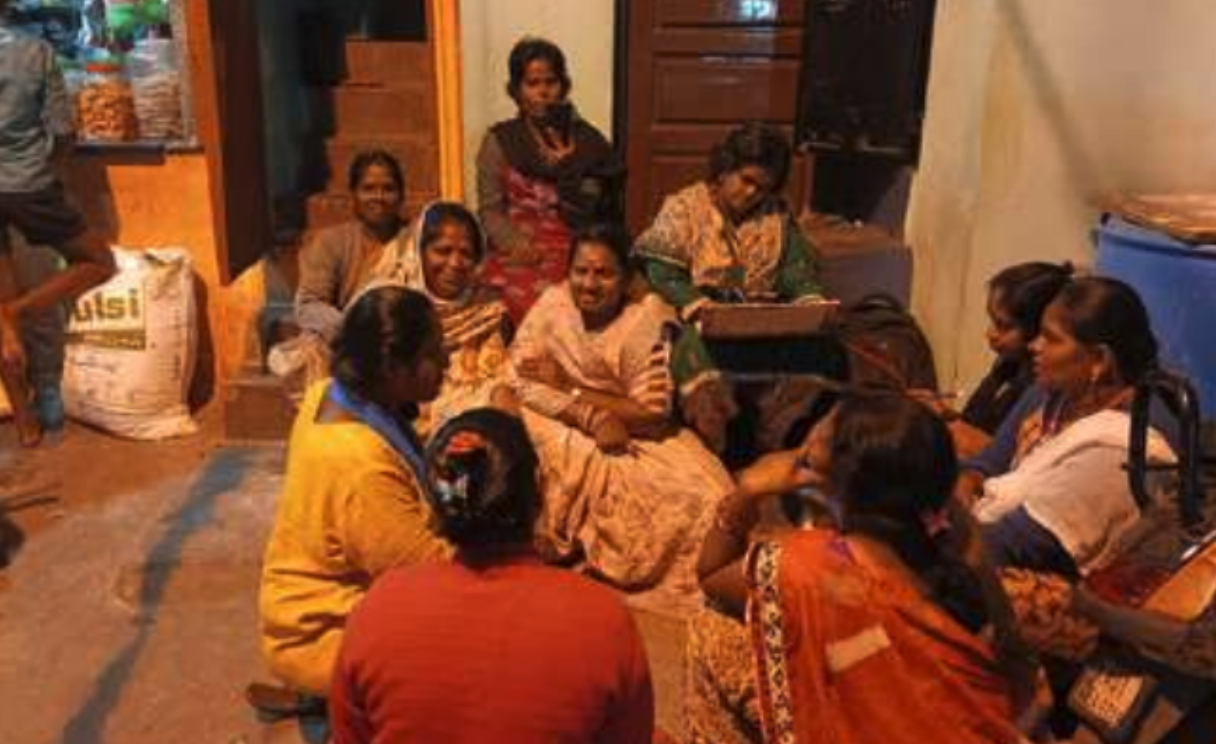
An SHG typically comprises ten to fifteen women from the same settlement who agree to meet regularly, save a fixed amount and lend from their pooled savings to members who need it. For a waste picker woman, it is often the first formal identity she has held: a group bank account, a passbook and a savings record that a bank or the National Urban Livelihoods Mission (NULM) can recognise. The groups receive on-ground support from twelve Community Resource Persons (CRPs), themselves members of the waste picker community. This means the person explaining a loan register is a neighbour rather than an outsider.
The group offers more than a place to save. It creates a space where women make decisions about money together, openly and on equal terms. When the Maramma Devi SHG marked its first year in June 2026, member Lavanya described what the group had resolved:
"No matter what happens, what the hardships are, we have decided that the Sangha must continue. It cannot fall apart. We believe in unity and shared efforts. We will ensure we meet every week, accumulate as much savings as possible, and see that the group is running smoothly."
Many SHGs struggle not because of a lack of ambition but because of how their financial records are maintained. One person, usually the most literate or confident member, becomes the sole keeper of who paid what and when. The rest of the group relies on her word. If she moves away, falls ill or makes a mistake, the group's records and often its trust go with her. In practice, this dependency frequently extends to the facilitator, with a CRP or NGO staff member quietly taking on the role of the group's accountant.
Sambhav's response, introduced in 2026, is the writers and checkers model. In each SHG, designated members are trained as writers, responsible for recording every transaction, including savings deposited, loans disbursed and repayments received. They maintain the savings register, internal lending register, loan repayment register, cash book and meeting minutes. Other members are trained as checkers, who cross-verify these entries against the cash and passbooks at every meeting. Both groups learn to fill in bank deposit challans, withdrawal slips and cheques.
Training takes place weekly during regular meetings rather than through a one-off session. It began with writers and checkers from eight SHGs, including Mallige in TC Palya, Sunrise in Giripuram, Blessing, Bhagyalakshmi and Madhura in Janakiram Layout, and Naagamma and Jhansirani in Vinobha Nagar.
This is where financial resilience and agency meet most directly. Writing an entry means a woman is the one recording, on behalf of the group, that money has changed hands. Checking gives a member the standing to pause a meeting and ask why the register and cash box do not match, regardless of who is leading it. And because these responsibilities are shared across several members, understanding how the group's money works is no longer the privilege of one woman or one facilitator. It belongs to the group.
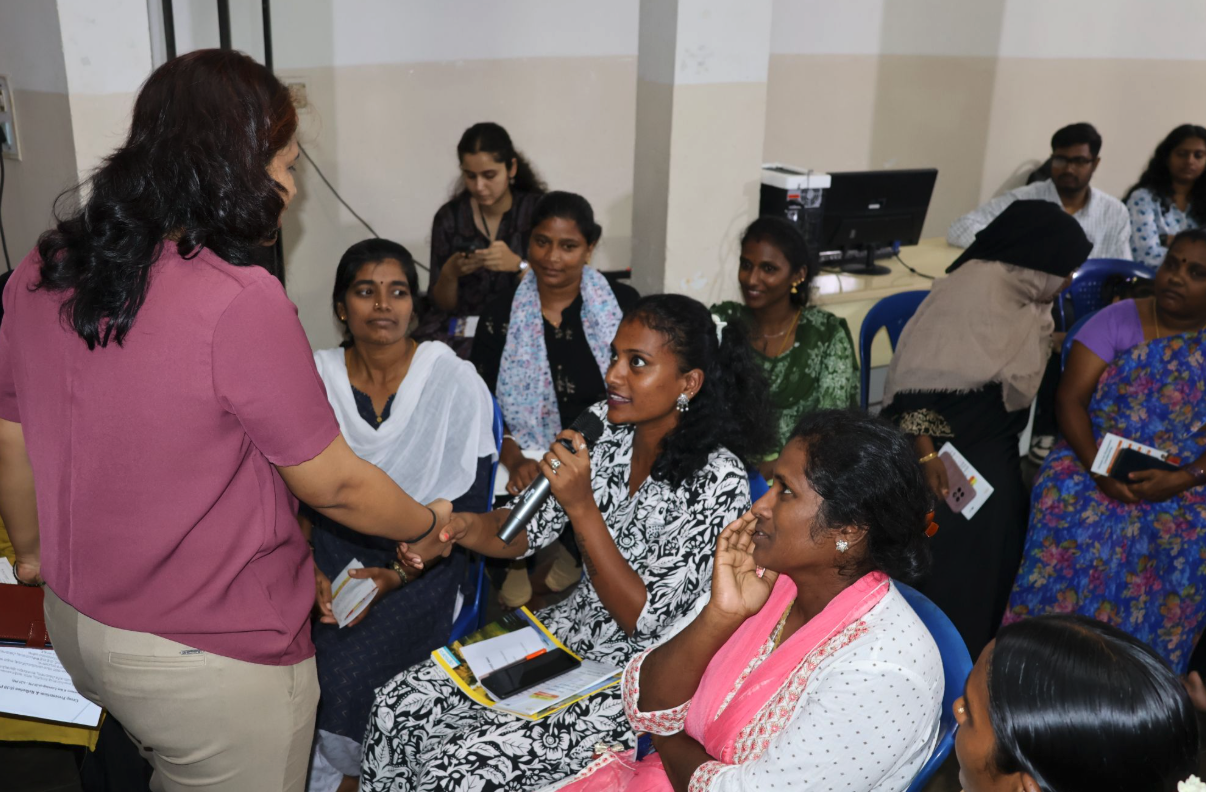
At Sangha Shakti 3.0 in Anandapuram on July 4, 2026, themed Nanna Sangha, Nanna Javabdari (My Sangha, My Responsibility), each group's president, secretary, treasurer, writer and checker stood up, explained her role to the room and picked a commitment chit pledging one concrete action for the month ahead. The day closed with a collective pledge, the Sangha Sankalpa, to regular savings, honest record-keeping, mutual support and independently run meetings.
On August 29, 2026, a financial literacy session led by Rashmi Shivayya of Canara Bank's South Regional Office at the JC Road SEED Centre gave this internal discipline a formal footing. The session covered digital banking, loan management, fraud prevention and government insurance and pension schemes. One participant in the focus group noted:
“I have learnt accountancy in college, but could not pursue my career further. Being the sole ledger keeper in my Sangha was an obvious decision. However, with CRPs, I am now training other members to learn basic accounts and maths on maintaining the book.”
The result is a group that can continue functioning even when a leader moves on, whose accounts can withstand scrutiny from banks and NULM without an NGO co-signing every transaction, and in which every woman can see exactly where her money is by looking at her group's register.
A savings buffer matters, but financial resilience is also reflected in how long an SHG can sustain itself after the CRP or NGO support is withdrawn. The changes emerging from these groups extend beyond their financial records.
Confidence to lead: In June 2026, six women managers from the Karumariyamma, Ashtalakshmi and Om Shakti SHGs — Bhavani, Priyanka, Kaamakshi, Chamundeshwari, Kavitha and Bhavya — were recognised at the Hebbal SEED Centre for their consistent attendance, sound record-keeping and mentorship of other members. Each spoke to the room about her journey. Women who had never belonged to a collective are now the people others in their settlements turn to for guidance on running a group.
A voice in household decisions: Lavanya's flower cart, set up with Sambhav's SEED support, has evolved into a shared household enterprise. She prepares the stock each day while her husband goes out to sell. “This sharing of responsibilities has helped us earn and also ensure that the household gets the attention it needs,” she says.
Groups such as Varahi Amman have gone further, participating in gender awareness training on household and community decision-making. The 2020 finding that half of the women believed decisions should rest with men has not yet been reassessed through a follow-up survey. However, these conversations are now taking place within the groups, among women and on their own terms.
Relationships that provide a safety net: Every internal loan represents one member choosing to trust another with the group's money, and a borrower choosing to repay her peers rather than turn to a moneylender. The group becomes the first place a woman turns to in an emergency and a space where members collectively decide how to respond.
The confidence to engage with institutions: In July 2026, two groups secured their first institutional loans from Canara Bank: Varahi Amman SHG in Narayanaswamy Garden received Rs 3.3 lakh for its 11 members, while Om Shakthi SHG in Ramanna Garden received Rs 5.5 lakh for its 11 members. At the felicitation, members themselves described their savings discipline and the steps they had taken to reach this milestone.
Earlier, in June, 14 members of the Maarammadevi SHG visited the Chennenahalli Grama Panchayat to learn from Venkatalakshmi, president of a 52-SHG cluster, how a federation of groups negotiates for access to schemes and larger credit. For women whose previous interactions with banks or government offices were often limited or intimidating, each of these experiences represents a new kind of institutional standing.
As of August 2026, Sambhav's programme is tracking 159 SHGs across 39 Bengaluru settlements, bringing together 1,682 members, close to 1,600 of them women. The groups have mobilised close to Rs 56.5 lakh in savings, of which about Rs 49.2 lakh is currently held as an active corpus under their own control. These savings are held across 90 formal group bank accounts, most of them with Canara Bank.
From this pool, members have lent each other Rs 12.98 lakh for emergencies and livelihood needs, with Rs 5.49 lakh repaid so far. This is a relatively young lending portfolio, still working through its first cycles. Meanwhile, 150 women from 59 SHGs have started nano-enterprises across eight categories, with home-based tailoring being the most common. Among those with complete records, average six-month revenue stands at around Rs 75,500.
When Saamuhika Shakti began, money was something that happened to a waste picker woman's household. Today, within these groups, it is something she saves on a fixed day, records in a register, checks against a passbook and lends to a neighbour she has chosen to trust.
Her relationship with the women around her has changed too: from a community where only one in five women had ever belonged to a collective to groups that have resolved to continue, whatever happens. Her relationship with institutions is also shifting, from standing on the far side of the counter to participating in bank felicitation ceremonies where she explains her group's track record.
The work is far from finished. Sixteen of the 159 groups are currently dormant; fewer than half of the members yet hold the NULM ID that unlocks subsidised credit, and the writers and checkers model is still being extended to group after group. The next step is to bring mature SHGs together into cluster-level federations, like the one the Maarammadevi members visited, so that collective bargaining power grows beyond what any single group can achieve.
Set against 22,500 waste pickers and a national movement of 10 crore women, 159 groups represent a beginning, not a conclusion.
By Gayathri Vasudevan, Co-founder & Chairperson, Sambhav Foundation
For most women in Bengaluru's waste picker settlements, money has always moved without a record. It came in from a day's collections and went out towards rent, food, school fees or a moneylender. Decisions about it were usually made by someone else.
Across 159 self-help groups (SHGs) formed with Sambhav Foundation, a Saamuhika Shakti implementing partner focused on livelihoods and skill development for Bengaluru's waste picker community, this is changing.
Women are saving together, lending to each other, walking into banks as account holders and, increasingly, maintaining their group's books themselves. Financial resilience is the visible result. Agency, a woman's ability to decide, question and act on her own terms, is what underpins it. And the ledger is where this transformation is easiest to see.
India has the world's largest women's SHG movement. As of June 2025, 10 crore women were organised into 91 lakh SHGs under the National Rural Livelihoods Mission, with a loan repayment rate above 96 per cent. A review of 34 SHG programmes, 18 of them in India, found tangible gains in women's economic control and community participation. However, this movement has grown largely through rural, formal channels, leaving Bengaluru's waste pickers outside almost all of them.
An estimated 22,500 waste pickers sort and recycle a large share of what Bengaluru discards, largely unrecognised and unprotected. Half of them are women, who earn roughly a third less than men for the same work. A typical waste picker woman had no savings to fall back on, no credit history that a bank would recognise and no collective identity that could be registered under a government scheme. When illness or a slow week of collections disrupted her income, the answer was usually a moneylender, whose interest rates could turn one bad month into several.
When Saamuhika Shakti was launched in November 2020, with Sambhav Foundation among its partners, the first survey found that only one in five women had ever belonged to a collective of any kind, while half believed household decisions should rest with men. Money, in other words, was something that happened to her household. It was rarely something she held, tracked or decided how to use.
An SHG typically comprises ten to fifteen women from the same settlement who agree to meet regularly, save a fixed amount and lend from their pooled savings to members who need it. For a waste picker woman, it is often the first formal identity she has held: a group bank account, a passbook and a savings record that a bank or the National Urban Livelihoods Mission (NULM) can recognise. The groups receive on-ground support from twelve Community Resource Persons (CRPs), themselves members of the waste picker community. This means the person explaining a loan register is a neighbour rather than an outsider.
The group offers more than a place to save. It creates a space where women make decisions about money together, openly and on equal terms. When the Maramma Devi SHG marked its first year in June 2026, member Lavanya described what the group had resolved:
"No matter what happens, what the hardships are, we have decided that the Sangha must continue. It cannot fall apart. We believe in unity and shared efforts. We will ensure we meet every week, accumulate as much savings as possible, and see that the group is running smoothly."
Many SHGs struggle not because of a lack of ambition but because of how their financial records are maintained. One person, usually the most literate or confident member, becomes the sole keeper of who paid what and when. The rest of the group relies on her word. If she moves away, falls ill or makes a mistake, the group's records and often its trust go with her. In practice, this dependency frequently extends to the facilitator, with a CRP or NGO staff member quietly taking on the role of the group's accountant.
Sambhav's response, introduced in 2026, is the writers and checkers model. In each SHG, designated members are trained as writers, responsible for recording every transaction, including savings deposited, loans disbursed and repayments received. They maintain the savings register, internal lending register, loan repayment register, cash book and meeting minutes. Other members are trained as checkers, who cross-verify these entries against the cash and passbooks at every meeting. Both groups learn to fill in bank deposit challans, withdrawal slips and cheques.
Training takes place weekly during regular meetings rather than through a one-off session. It began with writers and checkers from eight SHGs, including Mallige in TC Palya, Sunrise in Giripuram, Blessing, Bhagyalakshmi and Madhura in Janakiram Layout, and Naagamma and Jhansirani in Vinobha Nagar.
This is where financial resilience and agency meet most directly. Writing an entry means a woman is the one recording, on behalf of the group, that money has changed hands. Checking gives a member the standing to pause a meeting and ask why the register and cash box do not match, regardless of who is leading it. And because these responsibilities are shared across several members, understanding how the group's money works is no longer the privilege of one woman or one facilitator. It belongs to the group.
At Sangha Shakti 3.0 in Anandapuram on July 4, 2026, themed Nanna Sangha, Nanna Javabdari (My Sangha, My Responsibility), each group's president, secretary, treasurer, writer and checker stood up, explained her role to the room and picked a commitment chit pledging one concrete action for the month ahead. The day closed with a collective pledge, the Sangha Sankalpa, to regular savings, honest record-keeping, mutual support and independently run meetings.
On August 29, 2026, a financial literacy session led by Rashmi Shivayya of Canara Bank's South Regional Office at the JC Road SEED Centre gave this internal discipline a formal footing. The session covered digital banking, loan management, fraud prevention and government insurance and pension schemes. One participant in the focus group noted:
“I have learnt accountancy in college, but could not pursue my career further. Being the sole ledger keeper in my Sangha was an obvious decision. However, with CRPs, I am now training other members to learn basic accounts and maths on maintaining the book.”
The result is a group that can continue functioning even when a leader moves on, whose accounts can withstand scrutiny from banks and NULM without an NGO co-signing every transaction, and in which every woman can see exactly where her money is by looking at her group's register.
A savings buffer matters, but financial resilience is also reflected in how long an SHG can sustain itself after the CRP or NGO support is withdrawn. The changes emerging from these groups extend beyond their financial records.
Confidence to lead: In June 2026, six women managers from the Karumariyamma, Ashtalakshmi and Om Shakti SHGs — Bhavani, Priyanka, Kaamakshi, Chamundeshwari, Kavitha and Bhavya — were recognised at the Hebbal SEED Centre for their consistent attendance, sound record-keeping and mentorship of other members. Each spoke to the room about her journey. Women who had never belonged to a collective are now the people others in their settlements turn to for guidance on running a group.
A voice in household decisions: Lavanya's flower cart, set up with Sambhav's SEED support, has evolved into a shared household enterprise. She prepares the stock each day while her husband goes out to sell. “This sharing of responsibilities has helped us earn and also ensure that the household gets the attention it needs,” she says.
Groups such as Varahi Amman have gone further, participating in gender awareness training on household and community decision-making. The 2020 finding that half of the women believed decisions should rest with men has not yet been reassessed through a follow-up survey. However, these conversations are now taking place within the groups, among women and on their own terms.
Relationships that provide a safety net: Every internal loan represents one member choosing to trust another with the group's money, and a borrower choosing to repay her peers rather than turn to a moneylender. The group becomes the first place a woman turns to in an emergency and a space where members collectively decide how to respond.
The confidence to engage with institutions: In July 2026, two groups secured their first institutional loans from Canara Bank: Varahi Amman SHG in Narayanaswamy Garden received Rs 3.3 lakh for its 11 members, while Om Shakthi SHG in Ramanna Garden received Rs 5.5 lakh for its 11 members. At the felicitation, members themselves described their savings discipline and the steps they had taken to reach this milestone.
Earlier, in June, 14 members of the Maarammadevi SHG visited the Chennenahalli Grama Panchayat to learn from Venkatalakshmi, president of a 52-SHG cluster, how a federation of groups negotiates for access to schemes and larger credit. For women whose previous interactions with banks or government offices were often limited or intimidating, each of these experiences represents a new kind of institutional standing.
As of August 2026, Sambhav's programme is tracking 159 SHGs across 39 Bengaluru settlements, bringing together 1,682 members, close to 1,600 of them women. The groups have mobilised close to Rs 56.5 lakh in savings, of which about Rs 49.2 lakh is currently held as an active corpus under their own control. These savings are held across 90 formal group bank accounts, most of them with Canara Bank.
From this pool, members have lent each other Rs 12.98 lakh for emergencies and livelihood needs, with Rs 5.49 lakh repaid so far. This is a relatively young lending portfolio, still working through its first cycles. Meanwhile, 150 women from 59 SHGs have started nano-enterprises across eight categories, with home-based tailoring being the most common. Among those with complete records, average six-month revenue stands at around Rs 75,500.
When Saamuhika Shakti began, money was something that happened to a waste picker woman's household. Today, within these groups, it is something she saves on a fixed day, records in a register, checks against a passbook and lends to a neighbour she has chosen to trust.
Her relationship with the women around her has changed too: from a community where only one in five women had ever belonged to a collective to groups that have resolved to continue, whatever happens. Her relationship with institutions is also shifting, from standing on the far side of the counter to participating in bank felicitation ceremonies where she explains her group's track record.
The work is far from finished. Sixteen of the 159 groups are currently dormant; fewer than half of the members yet hold the NULM ID that unlocks subsidised credit, and the writers and checkers model is still being extended to group after group. The next step is to bring mature SHGs together into cluster-level federations, like the one the Maarammadevi members visited, so that collective bargaining power grows beyond what any single group can achieve.
Set against 22,500 waste pickers and a national movement of 10 crore women, 159 groups represent a beginning, not a conclusion.


